Student Research Page
Ssssnakes Alive!
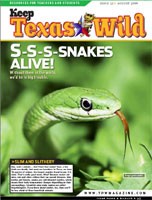
If you don't have a copy of the TPW magazine, you may print a copy of Ssssnakes Alive (pdf).
Let's talk about snakes!
 Snakes are reptiles. Reptiles are cold-blooded so they must warm themselves in the sun or on rocks. Snakes have skin covered with scales. Most snakes lay eggs, and a few species give birth to live snakes.
Snakes are related to lizards, but have no legs. Can you imagine life without arms, legs, no ears and no voice? How would you get food? How would you protect yourself from harm? Most snakes just try to get out the way. They'll crawl away and hide in piles of brush or rocks.
 Snakes are both prey and predator. Large birds such as red-tailed hawks and roadrunners eat snakes. Snakes help the balance of nature by eating prey that reproduces frequently, everything from earthworms to rabbits. Snakes also eat eggs. Snakes are especially important in the control of mice and rats. Rat snakes and bull snakes are a welcome sight around a barn or corn crib!
Snakes are skilled predators. How would you catch prey without paws or claws? Snakes grab prey with teeth that face backwards, making it hard for their prey to escape. Rough green snakes (Opheodrys aestivus), overpower their prey and often eat it alive. Rat snakes (Elaphe obsoleta) grasp prey in their mouths and quickly throw loops of their body around the prey, and then tightening their hold until the prey suffocates (called constriction). Venomous snakes have poison to inject in their prey. The venom keeps small prey still so the snake can grab it with its mouth and swallow it whole.
Sadly, snakes strike fear in some people's hearts, but 85% of snakes in Texas are harmless. Never-the-less, we get lots of questions about venomous snakes. Texas has two types of venomous snakes. First are the "vipers." Pit vipers have a heat-sensing spot on the sides of their heads that helps them strike their prey.
Here's a well-known viper - the rattlesnake. It has a triangular-shaped head, cat-like eyes and a rattle at the end of its tail. If you hear a rattle, stop, locate the snake, then slowly back away. Nine kinds of rattlesnakes are found in Texas, including the massasauga.
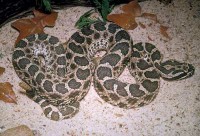
The Western Massasauga lives in prairies from the Gulf Coast up to the Panhandle
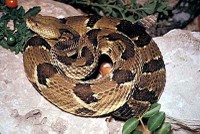
The Timber Rattlesnake lives in East Texas.
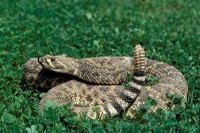
Western Diamondback lives in North, Central, South and West Texas.
Rattlesnakes usually "rattle" before striking, but if they are totally surprised, they may strike before rattling. Most of the rattlesnakes are active at night, when they hunt for prey such as mice, rats and rabbits.
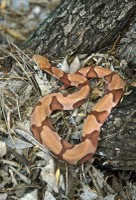
Another pit viper is the Copperhead. Copperheads are colored to blend in with leaves on the ground. It's possible to stare right at a copperhead without seeing it! Their venom is only about half the strength of rattlesnake venom. Copperheads bite rather than strike. Because they are so well camouflaged, most bites occur when a snake is accidentally picked up or sat or laid on. Always use care when picking up or flipping over logs, boards, old tin or other items where copperheads may be resting.
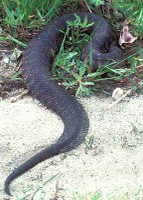
This pit viper is the cottonmouth or water moccasin, usually found near water. It swims slowly, often with its head out of the water, while other water snakes quickly wriggle across the water. It can be found in marshes, swamps, ponds, lakes, ditches, and canals in East and Central Texas and along the Gulf coast. It is a stubby, muscular snake and can grow to nearly six feet. When threatened, it will open its mouth to show its fangs. The inside of its mouth is white and reminded people of cotton, hence the name cottonmouth. They eat frogs, fish and small animals. These snakes can be very defensive and sometimes aggressive. They can bite underwater. Swimmers, bathers and anglers on river banks should always keep an eye open for these snakes.
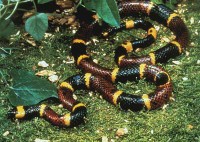
Besides the vipers, the other venomous snake we have is related to the cobra. It's the coral snake. Only one species of coral snake is native to Texas. The coral snake is shy and rarely seen. It has, in order, red, yellow and black colors. The coral snake has a small mouth, and is usually not aggressive. Its bites are dangerous, but very rare.
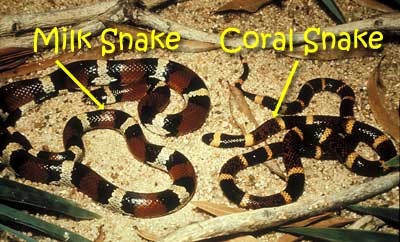
Other, harmless snakes have similar colors in a different order.
The rhyme "red and yellow kill a fellow" can help you remember that the coral snake's red and yellow colors touch, but the harmless milk snake has red touching black. The coral snake's venom is the most potent of all Texas snakes, but bites are extremely rare.
Keeping It Wild!

What should you do if you see a snake?
Leave it alone! Don't play with live or dead snakes. Watch when you step over piles of brush. or rocks and look before you put your hand on a rocky ledge.
The fangs of venomous snakes are long and sharp but they break easily. These fangs usually don't penetrate canvas tennis shoes and almost never penetrate leather shoes or boots. Watch carefully where you step, and wear boots in tall grass to prevent most snake bites. If you or a friend get bitten, you need to get to a hospital immediately.
Snakes are not something to be feared, but rather a creature to be respected as a fascinating and helpful member of the outdoors.
Learn More!
Videos: To learn more about how snakes move, capture prey and more, watch these videos:
- The Ultimate Guide to Snakes (howstuffworks.com)
- "Red-tailed Hawk vs. Rattler (National Geographic)