Donnie E. Harmel White-tailed Deer Research Facility
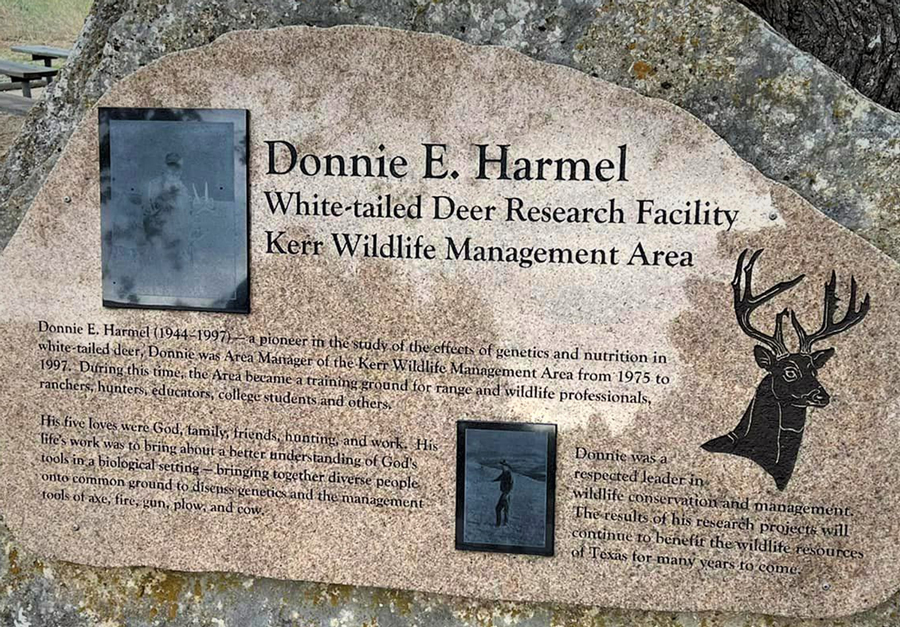
In 1974, a high-fenced research facility was built on the Kerr Wildlife Management Area (WMA) to study white-tailed deer. In 1999, it was dedicated as the Donnie E. Harmel White-tailed Deer Research Facility. Donnie Harmel served as the Kerr WMA Manager from 1975 to 1997 and was instrumental in establishing this research. The 23 acre facility consists of breeding enclosures, rearing enclosures and a series of alleys, chutes, crush and rotunda to facilitate the safe handling of research animals. The initial stocking of deer were all native Texas whitetails obtained from various locations throughout the State. The research herd has been maintained as a closed, pedigreed herd ever since; perhaps the only one of its kind in the world. Historically, the facility addressed the following objectives:
- To determine factors which contribute to antler formation in white-tailed deer.
- To determine the effect of nutrition on antler formation and body weight.
- To determine if deer which were spike-antlered at 1.5 years of age have the same potential for antler development and body weight in later years as deer which were fork-antlered at 1.5 years of age.
- To determine the influence of genetics on antler characteristics.
Since 1974, this facility has been used in a series of interrelated research projects to determine the role of nutrition and/or genetics in white-tailed deer. As a result of these studies, it was determined that antler development was genetically based and nutritionally influenced . In addition to these major studies, the facility has also been used to facilitate many pilot projects, breeding experiments, demonstration efforts and served as a focal point for numerous landowner field days.
Deer Facility Research
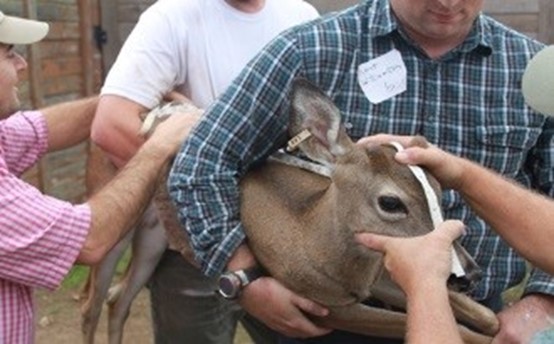
Deer facility research in action.
The three major components of a white-tailed deer’s body and antler growth are age, nutrition and genetics. Little was known about the role of these components prior to the Kerr WMA research facility.
Age
Though no studies were conducted specifically addressing age effects, data from the Kerr WMA research facility supports the now common knowledge that a buck’s antlers will increase in size with each year of age until it reaches maturity. In young individuals, more nutrients are utilized for body growth first and antler growth being second. As a buck approaches its full body growth, at about 3 to 4 years of age, there is less demand for nutrients in order to simply maintain body mass. At that point, more nutrients can instead be allocated to antler production. Under normal conditions, increases in antler growth (i.e. mass, points and spread) will occur until it reaches its peak, which is achieved at approximately 5 to 7 years of age. In post-maturity (8 plus years), as teeth become severely worn down and less efficient at breaking down food, nutrition levels decline which results in a gradual loss in both antler growth and body condition.
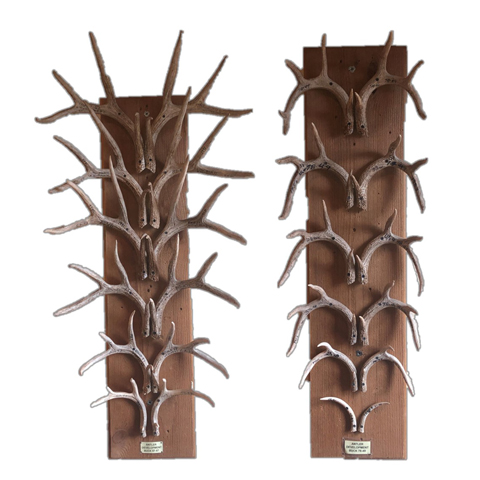
These antler boards show antler growth from 1 through 6 years of age for two individual white-tailed deer bucks. Under normal conditions, antler size will increase each year of a buck’s life until it reaches its peak growth, which typically occurs between 5 to 7 years of age.
Nutrition
All facets of a deer’s life demand a certain level of nutrition. Antler development, body growth, and reproduction require higher levels of nutrients (protein, energy, vitamins and minerals). Deer need to meet these nutritional demands through the available native vegetation found in their environment. If nutrition is adequate, then optimum antler growth and body weight can be achieved. However during times of low nutritional quality and/or availability such as during a drought or on overstocked ranges, a poor diet will result in sub-optimal growth. We examined the effects of two nutrients, protein and energy, on deer inside our research facility.
Dietary Protein Project
In this study, four groups of male fawns were placed on controlled diets and their body and antler growth monitored for 4 years. One group had a diet containing high protein (16% crude protein), one group had a low protein (8% CP) diet, and two groups had their diet alternated annually between high and low protein. It was determined from this study that an animal’s diet was an important component in body weight and antler development. Body weights were highest for the deer on a continuous diet of high protein. Antler growth also showed a direct relationship with diets. For bucks on the alternated diet, antler growth returned to normal on the high protein years, but even though weights also responded accordingly, it was found that deer may not reach their maximum potential body weight due to inadequate nutrition during early growth stages. The results of this study are published in the 1989 Texas Parks and Wildlife bulletin, Effects of Genetics and Nutrition on Antler Development and Body Size of White-tailed Deer PDF.
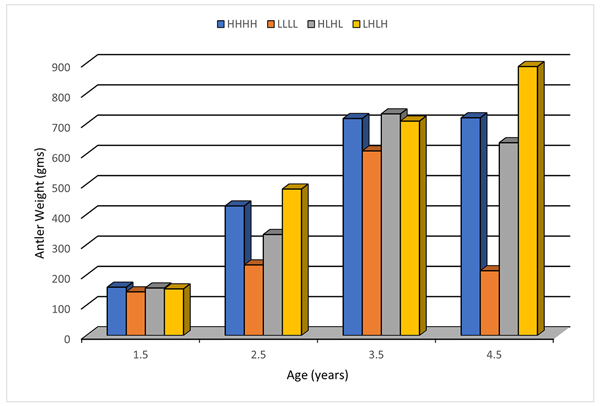
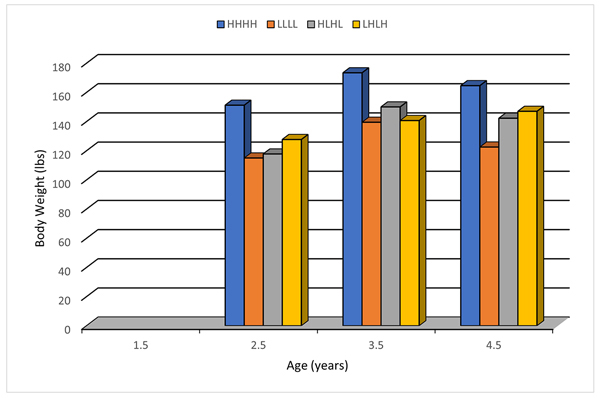
Dietary Protein Project Charts showing the effects of genetics and nutrition on antler development and body size of white-tailed deer.
Dietary Energy Project
Dietary energy (calories) is directly related to body growth and antler development in white-tailed deer. Limitations of energy correlated to environmental supply and individual demand are recognized, but its impacts have not been fully studied in white-tailed deer. We designed a multi-phased, long term research project examining the effects of energy in which groups of deer were raised and lived to adulthood on a standard or “normal” energy diet of > 2.8 kcal/g and a “low” < 2.2 kcal/g pelleted diet. Dietary protein was 16% in each diet with similar vitamin and mineral content. We did not create a “super energy diet”, but instead studied the effects at a sub-optimum level observed in deer habitats.
A second phase of research is underway in which the reproductive, survival and generational effects of energy can be evaluated.
We annually record live body weights, antler growth, skeletal growth and also assigned a body condition score (1 to 5) from visual inspection each fall. Preliminary results from the individual effects study indicates a difference in antler production, body condition and body weights, although effects varied by sex, age and group.
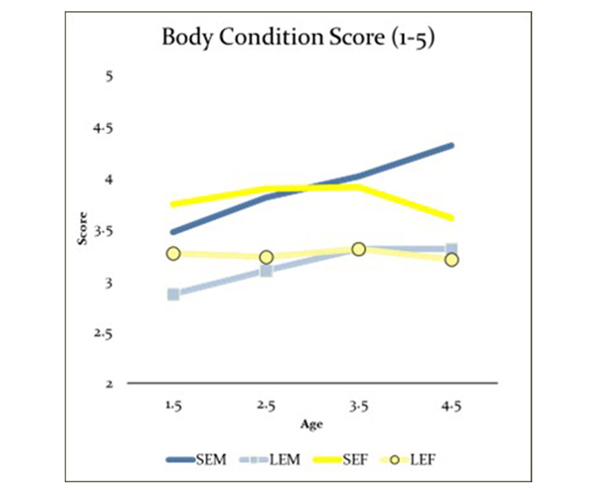
Body Condition Score. Average white-tailed deer body condition score on a scale of 1 to 5, where 1 equals poor and 5 equals obese, by age for males on standard energy levels (SEM), males on low energy (LEM), females on standard energy (SEF) and females on low energy (LEF).
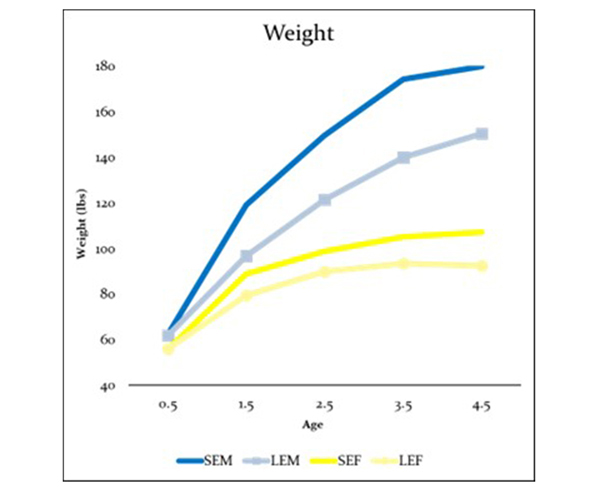
Weight. Average white-tailed deer body weights (pounds) by age for males on standard energy diets (SEM), males on low energy (LEM), females on standard energy (SEF) and females on low energy (LEF).
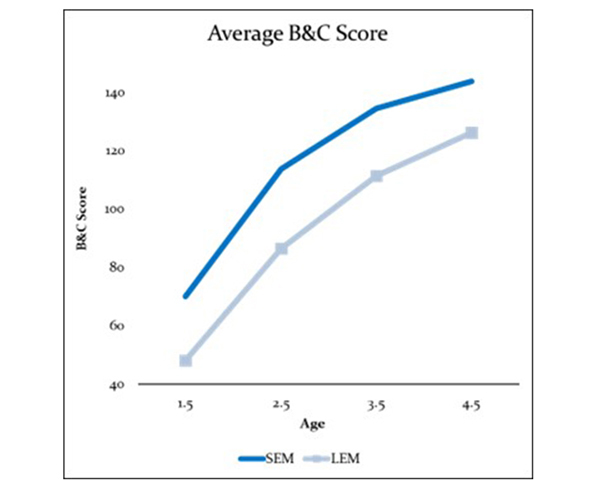
Average white-tailed deer Boone and Crocket score (B&C) by age for males on standard energy diet (SEM) and males on a low energy diet (LEM)
Genetics
Every organism expresses traits (hair color, body size, disease resistance etc.) determined by the genes they received from their parents. Antler growth in deer is also strongly determined by genetics. The genes serve as the framework or blueprint for how antlers are designed to grow, however other factors, particularly nutrition, can influence the expression of those genes. In other words, a deer under sub-optimal nutrition may not receive the nutrients required to reach its full genetic potential. Conversely, even if a deer receives an abundance of nutrition, they are limited by what their genes allow them to grow. For example, a mature buck genetically programmed to have 8 antler points is not likely to grow 12 points even with unlimited nutrition.
In the early years of the research facility, the differences in antler quality between individuals was investigated to see what role genetics played in antler growth. They focused on the 1.5-year-old age class, also referred to as yearlings, growing their first set of antlers. Some yearlings displayed spike antlers (those having only two, unbranched antler points) and others had multiple points (3 to 8 plus antler points) despite being on the same diet. The studies below demonstrate the timeline of investigations and how that research is applied in deer management. Genetic research advancements continue to refine our understanding of the role of genetics in deer herd health and management today.
Role of Genetics in Antler Development: 1974 to 1994 (790 deer, 566 sets of antlers)
In this study, seven male deer that were spikes as yearlings (1.5 years of age) were bred to a random group of unrelated does. These same seven sires were then bred back to their daughters (backcross) to concentrate the genes of the sires. The original unrelated does were then bred to a large antlered male that had six points as a yearling. Both spike sire matings, the spikes with the unrelated does and the backcross, resulted in a large number of offspring that also displayed spike antlers (31% and 60% respectively). However, the matings with the large antlered male with the same does resulted in only 5% of offspring with spike antlers. The progeny from all matings were followed until 3 years of age. There was a significant difference in antler production between the three types of matings. The results of these matings strongly indicated a genetic role in antler development from sires to offspring. All deer throughout this study were fed a free choice 16% protein diet. Nutrition was not a factor. This study is also reported in the 1989 Texas Parks and Wildlife bulletin, Effects of Genetics and Nutrition on Antler Development and Body Size of White-tailed Deer PDF.
Spike versus Forked Antlered Yearlings
In this study, antler production of fork-antlered (3 antler points or more) yearlings and spike-antlered (two antler points) yearlings were compared annually until 4 years of age to determine if deer of lower antler quality at a young age continued to grow smaller antlers throughout its life compared to better quality bucks of the same age. In other words, can we predict future antler quality based on a buck’s first set of antlers. We examined 144 individuals in this study that were on a standard nutritional plane their entire life. Results showed that, on average, fork-antlered yearling bucks continued to produce larger antlers each year relative to their spike-antlered counterparts. Results of this study are also published in the 1989 Texas Parks and Wildlife bulletin Effects of Genetics and Nutrition on Antler Development and Body Size of White-tailed Deer PDF.
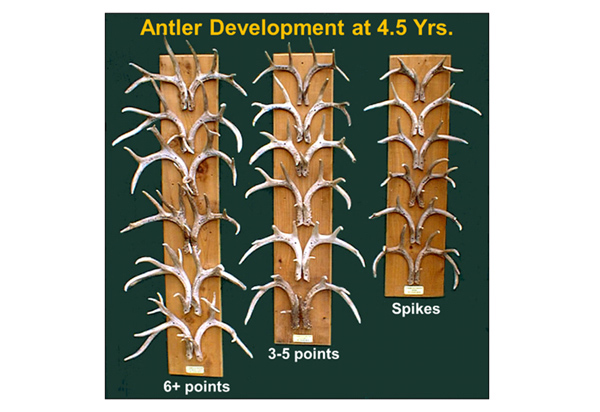
Antler Development at 4.5 Years. Antler sets from a study comparing antler quality from deer at 1.5 years of age (yearling) through 4.5 years of age (maturity). Each set of antlers in the display is from an individual buck at 4.5 years of age. The board on the right are bucks that were spikes at 1.5 years old, the board in the middle are from bucks that had 3 to 5 points at 1.5 years old and the board on the left all had 6 or more points at 1.5 years old. This study demonstrated that a yearling buck’s first set of antlers was a good indicator of its future antler quality.
Another related study compared antler production under field conditions of deer that were spike or fork antlered as yearlings. This study was conducted in a 96-acre deer-proof pasture over a four-year period. Deer were "range grown" without supplemental feed. Although small sample size prevented the two groups of deer from being statistically different, trend data indicated that antler production of fork-antlered deer surpassed that of spike-antlered deer. Results of this study are reported in Federal Aid Performance Report W-109-R Job 38: The Effects of Genetics on Antler Development and Body Size Under Field Conditions.
Heritability Study: 1986 to 1990 (483 deer, 531 sets of antlers)
We know that antler growth is strongly determined by genetics. However, what antler traits are more likely to be passed on from a buck to its offspring? To answer that, heritability for two body weights and five antler characteristics were estimated for white-tailed deer inside the Kerr WMA deer research facility. Single male breeding pens with 10 to 14 female deer were used for five consecutive generations. To minimize selection and maintain a broad genetic base, different sets of sires and as many different dams as possible were randomly assigned as breeders each generation. Traits were measured at 1.5 years of age. Heritability was estimated utilizing (1) sire and within-sire components of variance, and (2) regression of male progeny performance on sire performance. Theoretically, these procedures estimate the amount of additive genetic variance present in a population without indication of non-additive genetic (dominance and epistasis) and maternal effects. A given trait’s heritability can range from 0.0 (not heritable) to 1.0 (highly heritable). Results in this study ranged from 0.00 to 0.17 (birth weight), 0.58 to 0.64 (body weight), 0.22 to 0.56 (antler points), 0.47 to 0.70 (main beam length), 0.03 to 0.43 (antler spread), 0.80 to 0.89 (basal circumference) and 0.71 to 0.86 (antler weight). All traits, except for birth weight, were moderately to highly heritable. This suggests that genetic change could be expected from individual selection if realistic selection differentials were used. Results of this study are published in the scientific journal Heredity (Williams et al. 1994)
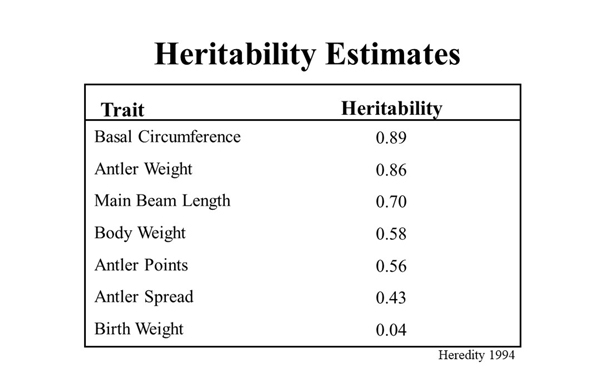
Heritability Estimates of Traits chart.
Genetic/Environmental Interaction: 1992 to 1999 (483 deer, 482 sets of antlers)
Based on previous research from the deer facility, we know that genetics plays a strong role in determining a buck’s antler quality and that nutrition must be adequate for a deer to reach their optimum growth. Nutrition availability can vary greatly and therefore can influence the resulting antler growth. We can basically place deer into three groups. One group will always have poor antler quality regardless of nutrition, one group will always have good antler quality and then the third group, which makes up the bulk of the herd, will display variable quality depending on the level of nutrition. We termed them “swing” deer. During years of adequate nutrition, they will have good antler quality and during times of nutritional stress they will have poor antler quality. If a manager is attempting to intensively remove bucks with lower antler quality from the breeding population, then those years of abundant nutrition will mask the swing deer and protect them from harvest. Conversely, during periods of drought or on over utilized ranges, more of the swing deer will have poor antler quality and thus allow them to be identified for removal. This should increase the odds that only the better quality deer will remain and pass on their genetics. We demonstrated this with a study titled “Genetic and Environmental Interaction in White-tailed Deer” or “Stress Study” for short.
In this study, fawns were weaned in October and were placed on an 8% protein ration and their daily intake also was highly restricted (approximately half of normal intake) to simulate drought effects. The deer were raised on this limited ration until they completed their antler growth the following October. Each year, the six yearlings that exhibited the best antler growth on this limited diet were used as brood bucks and bred to unrelated does. Their offspring were weaned in October and placed on the lower quality ration. This process was repeated each year with the yearling buck progeny from each mating.
Data from this study indicate that there is a genetic and nutritional interaction that governs "swing deer." They also suggest the best time to harvest deer with lower antler quality and make genetic improvements is during periods of nutritional stress. One of the best scenarios to harvest swing deer is when starting a habitat management program on unmanaged ranches when deer numbers may be excessive and substantial herd reduction is needed to improve habitat.
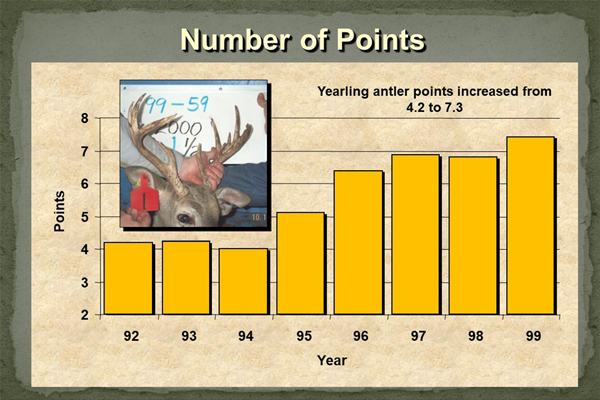
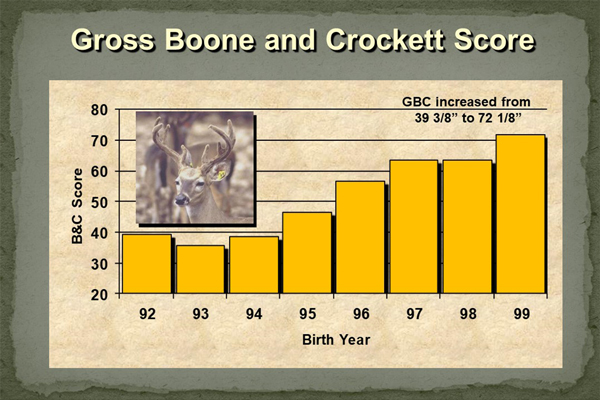
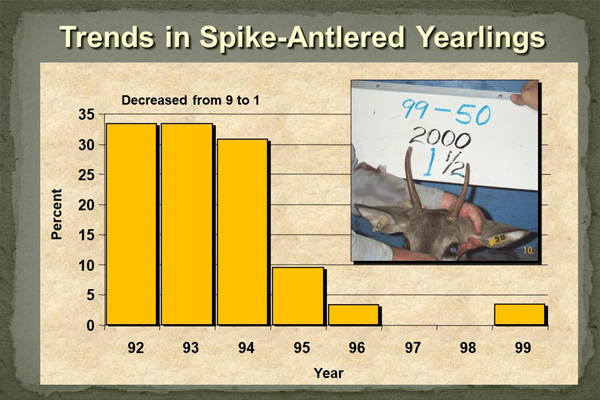
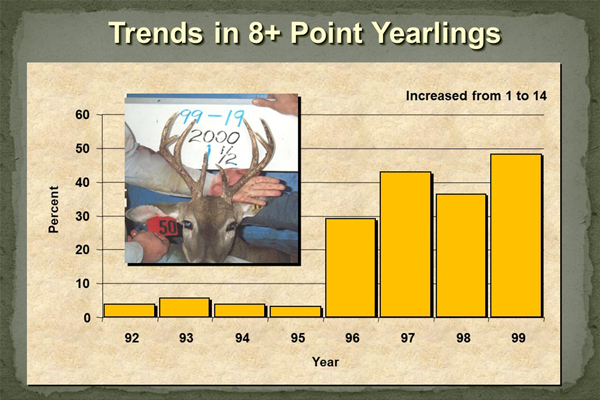
Charted data from the “Stress Study” that shows changes in antler quality over an 8–year period. All bucks were placed on a limited, low nutritional diet to simulate drought conditions. The top 6 bucks each year were selected to be sires for that breeding season. This study showed that antler quality in a herd could be improved by intensively selecting for desirable antler traits during times of nutritional stress.